|
| One Hundred Years of Film Sizes |
One hundred years of cinema is also due to acceptance of one standard gauge. Whereas film equipment has undergone drastic changes in the course of a century it is a little miracle that 35mm has remained the universally accepted film size. If film had followed the same course as video, with its continuing change of systems, the development might have been delayed considerably.
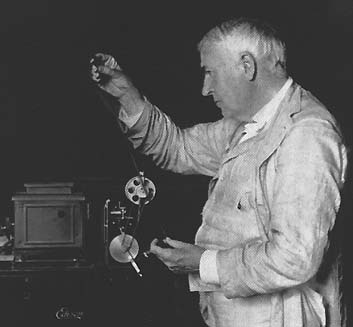
We owe the format to a great extent to Edison (see photo) - in fact 35mm was called the Edison size before.
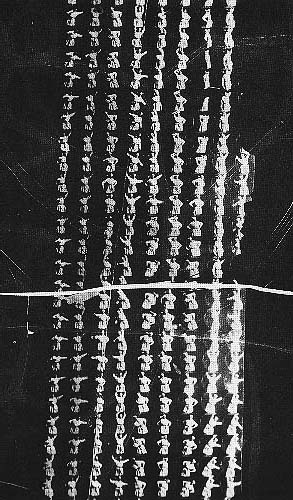 Click on icon for Monkeyshines Edison film strip of 1890
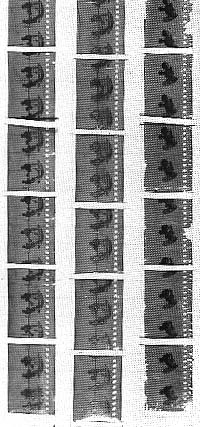 Edison Kinetograph film strip of June 18th,1891 (click)
In 1889 W.K.L.Dickson of the Edison laboratory ordered a roll of film of 1 3/8"(34,8mm) width from George Eastman. It was to be used in a new type of Kinetoscope for moving images on a strip of celluloid film, which could be viewed by one person at the time.
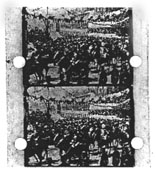
The Lumière brothers introduced in March 1895 their Cinématographe for 35mm film, which was also used at their first public show of 28 December of that year. Their strip of film had only one round hole per image, whereas Edison used four rectangular perforations per frame. Even at that time there was already a variety of widths:
The abovementioned William Dickson, after leaving Edison, used 68mm for his Mutoscope &
Biograph Company' productions to avert Edison's patent rights. Cameramen of this company
travelled through Europe and produced documentaries of a remarkable quality.
Widescreen also proved excellently suitable for other subjects.
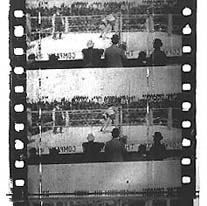
In 1897 more than 10.000 feet of 63mm film was shot of the then famous box match between Corbett and Fitzsimmons.(see photo frame clip)
One of the problems to be dealt with was the strength of the film base. Because film is pulled through the filmgate in short strokes it comes under high tension. Therefore perforations were torn time and again. Eastman Kodak overcame this weakness by doubling the thickness of the nitrate base, which was normally used for film packs from 1896 onward.
By the turn of the century film appeared to become big business. the struggle for the monopoly of the patents intensified. To avoid lengthy court cases the nine major producers of the time decided to pool their rights in the Motion Pictures Patents Company in 1909. This consortium threatened to outlaw outsiders from further film production. Despite the general outcry one favourable effect was that 35mm became standardized. It was adopted a.o. by the Congrès International des Editeurs de Films in Paris in the same year. It was named standard-size stock, in Germany Normalfilm and in France pélicule format standard.
This does not imply that no further attempts were being made to introduce other gauges. The standard size was besieged continuously for reasons of economy, projection quality or aesthetic design.
A fierce competition raged in the amateur market. Economy and dimensions were the chief ingredients. The public had to be won over by relative inexpensiveness. Amateur film was usually cut from 35 mm professional raw stock , that was produced in big quantities and therefore economical to buy. The film was cut in two or three lengths - the substandard size, or "Schmalfilm" in Germany.
The first attempt was demonstrated in England by Robert Paul and Birt Acres in 1899. Their
camera, projector at the same time, the Birtac, used 17½ mm size with perforations on one side.
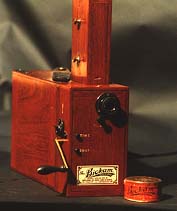
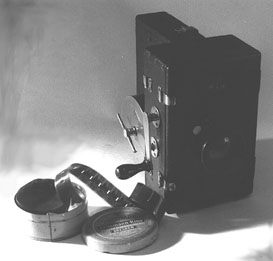
 A few months later followed by the Biokam (see photo and filmframe) (for £ 6.6/-), also in 17½mm (see frame, but perforations in the center between the images.
It was not a success, a.o. because of the proficiency needed to
produce acceptable results.
In the same year J.A.Prestwich introduced 13mm equipment, but little was heard of it since.
More succesful was Heinrich Ernemann, who introduced in 1903 the Kino I. It used the same film as the Biokam. This apparatus could also be used for both taking and projecting pictures - a combination which has been experimented with for years without much success, lately by the American Wittnauer Cine-Twin 8mm set.
In 1900 Gaumont-Demeny ventured with an unusual size: 15mm, with center perforation. The Chrono de Poche did not make it either. Nowadays it is a rarity. In the same year another French firm introduced the Mirograph which used an equally odd size: 21mm. It had on one side notches instead of perforations. I have yet to see one single specimen.
In 1897 a fierce fire destroyed the cinema pavillion of a charity bazar in Paris, which took the lives of 124 people. It is no surprise that an immediate search was opened for a replacement of the highly inflammable cellulose nitrate. In 1908 the first non-flam acetate film was marketed. It took decennia of perfection before it could supplant the old stock. Only in 1950 the tri-acetate film could be considered equal to nitrate film. However, for amateur films it was employed right after its invention.

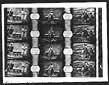
In 1912 Edison introduced the Home Kinetoscope for safety film. It employed yet another size: 22mm. It had three rows of images sized 4 x 6mm, separated by two rows of perforations. One column of images was cranked foreward, the middle row backward, and the third row forward again. A camera was never produced. Films from 10 to 15 meter lengths in special containers were for rent from Edison depots or by mail.
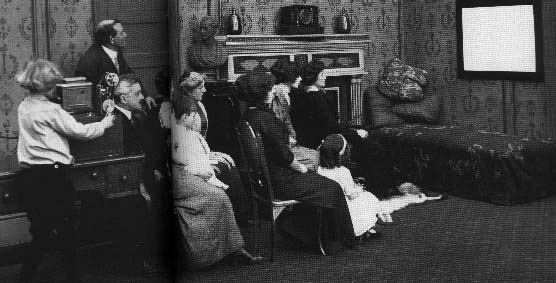 Home Kinetoscope show (click on icon)
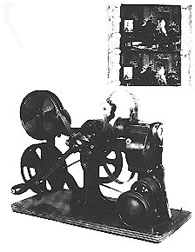
In 1912 Pathé introduced with far more success a 28mm size for safety film. The width
deviated in order to prevent flammable normal sized film be used for the projector, the Pathé
Kok (see image). In the United States 28mm was accepted as a standard size for portable film projectors by
the Society of Motion Picture Engineers.
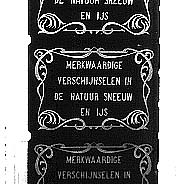 In France the film had on the left side three
perforations per frame and on the right side one (see image). The single right side perforation was to make
framing unnecessary.
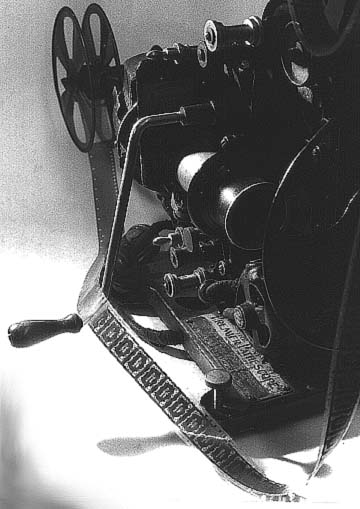
When during WW1 imports from France into the U.S.A. came to a halt Victor introduced their Safety and Home Cinema projectors for 28mm films perforated with three perforations per frame on both sides. Pathé' distributor W.B.Cook designed a completely new motorized projector, the New Premier Pathescope (see photo). Not many were sold, however.
The Pathé Kok projector (The name was taken from from the newly patented logo of a kock)
was equipped usually with a dynamo. So it could be used on the not yet electrified countryside.
At the same time 28mm cameras were marketed. The emphasis was on showing theatrical films
copied from the large film library of Pathé, however.
Initially the new size seemed to do well and was accepted as a standard size for the home
cinema. 935 Titles were for rent. Later developments made it decline in popularity. Yet the
Kok projectors are a showpiece in a collection nowadays, especially so because of its
splendid design resembling a robust old-time sewing machine.
Besides emulsion on film base experiments were carried out with celluloid and glass plates.
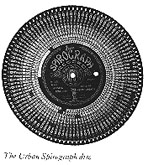
All these curious attempts make a fine hunting field for the collector nowadays. A Kammatograph was auctioned by Christies for £ 3850 in 1993 .

After thirty years of experimentation with different widths in 1922 one was marketed which stood a better chance. In December 1922 Pathé introduced its home cinema, Le Cinéma chez soi, called the Pathé Baby.
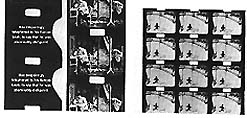
Between the perforations of 35mm film three rows of 9,5mm were slit (see image).
The projector came first. Its transportation mechanism was almost identical to the Lumière
Cinématograph of 1895. The apparatus projected a steady image of amazing clarity
considering the lamp of 6 Watt. Cassettes with lengths of 10 or 15 meter 9,5mm film could be
bought or rented from depots. These films stood out by their great definition. They were
reduced from Pathé's considerable 35mm archive. Subjects included newsreels, documentaries,
comedies and feature films. Some were colored by a stencil imprint method. An ingenuous
system was used to prolong the projection time. By means of notches in the film a mechanism
was set into motion in the projector by which certain images - titles or close-ups - could be
frozen for a few seconds.
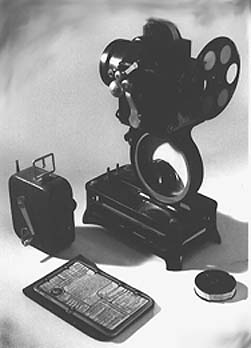
In 1923 a camera with hand crank was marketed. It being small in size, handy and economical, made it popular in a short time. It was for the first time that amateur film gained a wider acceptance. It is estimated that some 300.000 projectors were sold. Where they have remained is another matter. They are not that often being offered for sale nowadays.
As a result of later developments the size never became popular in the U.S.A. In Europe it was. Even in Japan imitations of 9,5mm movie cameras and projectors were manufactured before the war. In 1938 9,5mm sound film was introduced with the Pathé Vox sound-projector.
It may come as a surprise to some but 9,5 mm still has a following. Cameras and projectors are
still manufactured, or more precisely, modern equipment is being converted to this size. Films
are still re-perforated by some firms and developping facilities are available, given enough
patience.
Internationally 9,5mm fans form a closely knit community holding yearly global gatherings. The
best nine-five films of that year are projected then.
Kodak could not lag behind Pathé. It had already been experimenting with another size. In 1923 it hit back with the 16mm gauge, initially with perforations on both sides. In the battle for the amateur market Pathé boasted that its size was cheaper because of its economical use of the film width. Its prices were also better. In later years Pathé claimed that she delivered almost the same frame size of 16mm for the cost of 8mm.
Kodak opposed that middle perforations could cause stripes over the image. Moreover if the
projector claw failed to hit the perforation accurately the images could easily be damaged. The
grain quality would be much better in 16mm. Kodak introduced with 16mm a reversal
developing process with variable second exposure. It did away with the procedure followed so
far to have negative film copied onto positive stock. As a result the costs were reduced to only
1/6 of the negative/positive process.
In later years a sound track was added on one side sacrificing one row of perforations. It was
accepted as an SMPE standard in 1932.
In the twenties Pathé were considering a new size of film for projectors used for shows in places in the country where no cinema was operating as yet. They chose for a size used often in the past: 17,5mm. an optimum use of the film width was obtained by expanding the image and reducing the size of the perforations on both sides. The Pathé Rural was obtainable from 1926. Pathescope, Great Britain, followed with the Pathé Rex projector only in 1932. At the same time a film library was made available with well-known films of that era. In 1932 sound film was introduced - the sound track replacing one row of perforations as in 16mm. Although 17,5mm en joyed some popularity before the war - it was used in 4823 cinema's in France - it disappeared in Great Britain in 1939. In France in the first war years as the German occupation power did not permit off-gauge films be shown for censorship reasons.
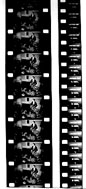
In 1930 Kodel pioneered in the United States with the idea to reduce film costs drastically by ia yet more economical use of the 16mm width. With an ingenuous mechanism they succeeded in inserting 4 images on the surface of one 16mm frame. Besides the Kemco Home Movie camera a dual size projector was introduced for 16mm and 1/4x16mm.
The death blow was given to this attempt when Kodak introduced 8mm film in 1932. 16 Mm was given twice the number of perforations. First one half of the film was exposed. Thereafter the reel was turned and the other half was shot. After processing the film was slit in the middle and the two 8mm halfs spliced together. In this manner as many frames were available on the 25ft small reel as on 100 ft 16mm film.
Because changing reels in the middle proved to be cumbersome a number of manufacturers introduced straight 8mm wound on 50 ft reels (Univex, Bell & Howell), or in cassettes (Agfa). Because of the lack of uniformity and resulting in limited availability straight 8mm did not catch on.
In spite of its advantages nine-five lost field. Kodak had acquired Pathé in the late twenties. It had no interest in pushing that size actively. The supremacy of 8 and 16mm lasted for a considerable number of years.
Pathé made a last attempt to hook on to the popularity of widescreen in the fifties by introducing a duplex and monoplex format in 1955. 9,5Mm was double perforated and split in the middle to a 4 3/4mm size which was to be projected horizontally in widescreen. It was an ill-conceived idea. The public showed no interest at all. Few cameras and projectors were sold. The venture was abandoned soon and forgotten in no time. Available stock was converted to the classic 9,5mm size. The 4 3/4 mm Lido Duplex camera and the Monaco projector have become real collectors items.
Eight millimetre also underwent a transformation in 1965. The frame image was enlarged by 50% by using smaller vertical perforations. The so called super 8 film was supplied in 50' 8mm cassettes. As from 1973 with magnetic sound stripe. Fuji attempted to introduce a far better conceived single 8 mm system but could not compete with Kodak.
For semi-professional use double super 8 was supplied in the manner of standard 8mm on 16mm 100 ft. reels. It gave far better results because the film passed through the precision film gate of the camera instead of that of the magazine. In addition to the larger frame size and the improved emulsion super 8 compared well with 16mm of the fifties. No wonder that 16mm was hardly used anymore by amateurs.
Instead 16mm was used more and more by professionals. Especially nowadays after the introduction of super 16 mm in 1971. Like super 8 a far more economical use was made of the film surface by smaller vertical perforations. As a result the 16mm image was enlarged by 40%. This film size is excellently suitable to be blown up to 35mm. Because of its widescreen dimensions it lends itself perfectly for modern televion systems, like Pal Plus.
As stated before widescreen became popular in the fifties. However, it was proceeded by various attempts in the past, even in the nineteenth century as we have seen before, followed by:
All these ventures did not last for much longer than a year. In the fifties another series of attempts were made to introduce large film sizes for widescreen. To name a few:
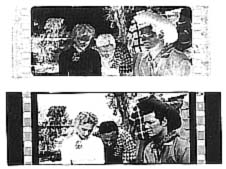
Frame of "Oklahoma" in 65mm Todd-AO. Film was printed onto 75mm colour film
In the seventies followed IMAX (1970), OMNIMAX (1973), Cinema 180 and others with horizontal position of frames on 65mm film. Special theatres were built to accomodate the projectors and ultra wide screen. Specially built projectors were needed because the film could not be pulled through anymore by claw. In the Imax system it is transported by a wave motion. Thanks to the air pressure gate precision projection on a 180º 100 ft. width screen have become possible.
From the foregoing it is clear that standardization was dictated by the economical power of one or more manufacturers. One result was was the universal acceptance and growth of the medium for amusement, information and in some cases as an art form.
For the collector hard to find off-gauge equipment/films are a true hunting-ground. In particular the sizes that were never heard of anymore. One may still profit from the relatively low prices as compared with photographica. 8, 16 and 35mm equipment/films are often offered for sale. But it becomes more difficult with 9,5 or 17,5, 28mm and all the other sizes.
One hundred years of cinema has yielded almost one hundred film formats. Most of them have been relegated to oblivion much to the detriment of its inventors/manufacturers. Each size has its own history. It is outside the scope of this article to go into details. I may refer to the link.... detailing most of these gauges. For further links see my Cinematographica page.
© Michael Rogge
This article was published originally in Dutch in the quarterly of the Fotografica Society, Netherlands, in 1996.
On the web since 6 December 1996. Update: 27 April 1997
Any suggestions? Click here to send me an email message
Return to index-page